PSPK
PSPK
 0
0


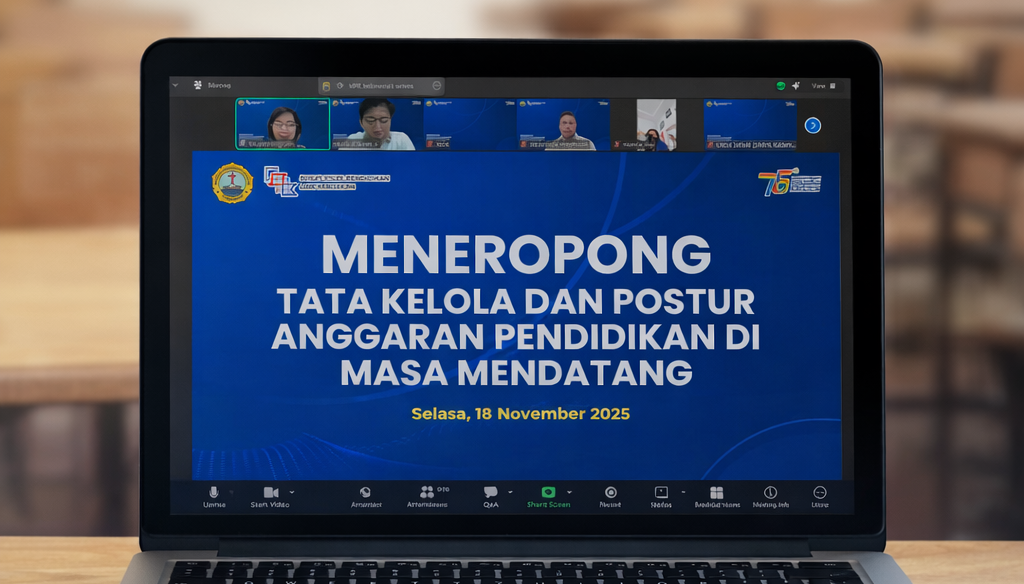
Jakarta, 18 November 2025 — Major reforms in Indonesia’s education system are entering a critical phase. The Constitutional Court’s ruling on free basic education, alongside deliberations on the National Education System Bill (RUU Sisdiknas), has triggered a comprehensive reorganization of education governance, financing, and service delivery structures.
These strategic issues were the focus of the webinar “Revisiting Education Governance and Budgetary Posture for the Future,” organized by MPK Indonesia in collaboration with the Center for Education and Policy Studies (PSPK). The discussion brought together cross-sector stakeholders to examine both the challenges and opportunities in ensuring equitable, inclusive, and sustainable education.
Chair of Commission X of the Indonesian House of Representatives (DPR RI), Hetifah Sjaifudian, emphasized that through the National Education System Bill, Parliament is restructuring the national education system by promoting 13 years of compulsory education, free basic education including in private schools, and reforming the 20 percent mandatory education spending to ensure it is better targeted.
According to Hetifah, the Constitutional Court ruling must be followed by technical and realistic financing mechanisms, including funding for private elementary and junior secondary schools, affirmative measures for disadvantaged regions, and fulfillment of minimum infrastructure standards. She also highlighted that the ministry responsible for education has yet to fully function as the lead institution in education governance and budget allocation due to limited authority.
“Throughout the legislative process, Parliament has opened space for input from the public, MPK, and PSPK as part of our commitment to developing transparent, inclusive, and integrity-driven regulations,” said Hetifah.
Member of the Higher Education Council, Amich Alhumami, explained that with 67.3 million children from early childhood education to senior secondary level, the implementation of the Court’s ruling and the expansion of compulsory education to 13 years will have significant fiscal implications. Although the 2025 education budget has reached Rp725 trillion—the largest in history—its allocation structure does not yet fully reflect real needs on the ground.
He noted that the government has prepared four alternative financing schemes for compulsory education to ensure the policy can be implemented realistically and sustainably.
Chairperson of MPK Indonesia, Handi Irawan, highlighted the impact of the Constitutional Court ruling on faith-based private schools, particularly Category D–E Christian schools that have long struggled with limited funding. He noted that the policy has the potential to be both a lifeline and a pathway toward more equitable education services.
However, he cautioned that expanding compulsory education places early childhood education (ECE) at a critical juncture, requiring large-scale establishment of ECE centers and the readiness of qualified teachers. “If church and school ecosystems are not prepared, we risk repeating what happened in 2009, when the best ECE teachers moved to public schools,” he said.
From a public policy perspective, Yeremia Dwi Hendryanto, PSPK Researcher, stressed that the main challenge lies not only in the size of the budget but also in the unclear definition of the education function within the state budget. This has allowed many non-education programs to be counted toward the 20 percent mandatory spending requirement, resulting in allocations that do not fully reflect actual education needs.
He called for structural reforms through clearer definitions of education functions, greater budget transparency, and strengthened affirmative policies for disadvantaged regions.
The webinar underscored one key point: Indonesia is entering a decisive phase of education reform that will shape the future of its next generation. The collaboration between MPK and PSPK reaffirmed that reforms—from the Constitutional Court ruling and the National Education System Bill to improvements in budget governance—must be guided by principles of transparency, child-centeredness, and the strengthening of education ecosystems across all regions.
This momentum must continue to be safeguarded to ensure that transformative changes truly deliver a more equitable, inclusive, and high-quality education system for all Indonesian children.